SEO + GEO (Search Engine & Generative Engine Optimisation)

Found where your buyers actually search. Google. And AI.

You get sustained, qualified traffic from Google - and citations inside ChatGPT, Perplexity, Google's AI Overviews and Claude, where more of your buyers now ask their questions.

Search is changing. Some buyers still Google. More and more ask ChatGPT or Perplexity. The winners in the next five years will show up in both. We build the technical foundation, content and authority that gets you found in whichever channel your buyer chooses.

See what we'd do differently

Search is splitting into two channels. Most businesses are only investing in one.

For twenty years, being found meant ranking on Google. That still matters - but a growing share of buyer research now happens inside ChatGPT, Perplexity and Google's own AI Overviews. The businesses that show up in both are getting compounding advantage. The businesses that focus on old-search alone are quietly losing share to competitors already appearing in AI answers. This is the moment to be in both.

The outcomes. And how we deliver them.

The outcome you can expect
How we deliver it
Steady traffic without paying for every click
Technical SEO foundation
Visibility on both Google and AI
Content that earns visibility
Compound returns over time
Authority-building outside your site

Why we can do this when others can't.

Technical foundation, done properly

Most SEO agencies produce content first and hope the technical side follows. We do the technical work upfront - because content on a broken foundation quietly underperforms, no matter how good the writing.

Content that earns citations, not just clicks

There's a difference between content written to rank on Google and content written to be quoted by AI. We build for both - because the same buyer might reach you through either channel next week.

Sustainable, not tricks

No black-hat tactics, no link farms, no shortcuts that get penalised in six months. The work compounds because it's the real thing - and it survives the algorithm changes that keep coming.
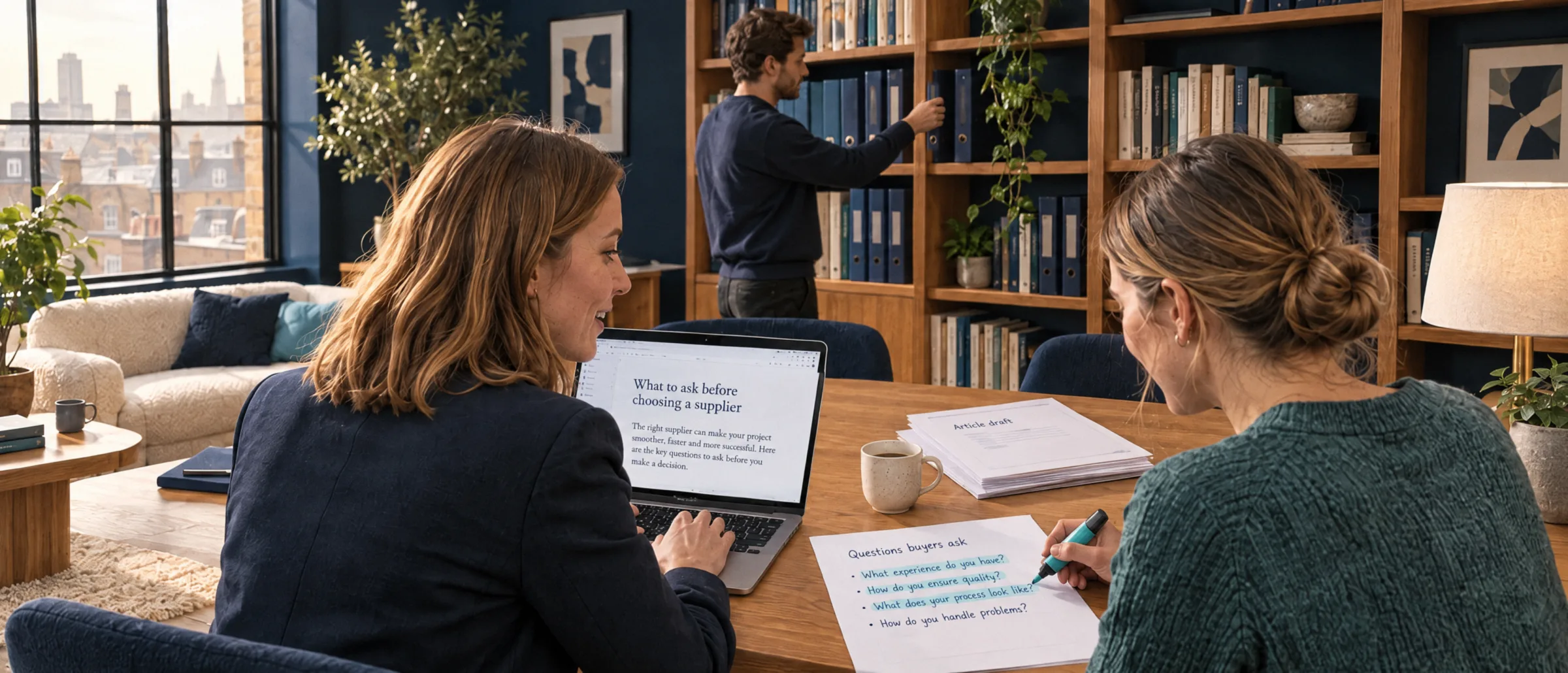
Team collaborating around a laptop, candid working moment

Four steps. No mystery.

01 — AUDIT
Map current visibility

Your current visibility on Google and in AI answers. What's ranking, what isn't, what the technical health looks like, and where your competitors are getting ahead.

02 — PLAN
Prioritise what moves the needle

A prioritised roadmap of technical fixes, content to create and authority signals to build. Honest about what will show early wins, and what takes six-plus months to compound.

03 — BUILD
Ship the work steadily

The technical fixes get shipped. Content gets written and published. Authority-building work runs in the background. Steady, structured work, not one-off pushes.

04 — COMPOUND
Keep learning, keep gaining

Monthly review of what's ranking, what's being cited, and what to reinforce. The work builds on itself as we learn what your buyers respond to and what search engines reward.

Curious where your business currently shows up - and where it doesn't? A free 30-minute audit will show you.

See what we'd do differently

Recent work in search visibility.

Workspace with monitors, hands at keyboard, real work in progress
ChemComplex · Flagship case

Qualified pharma and chemical enquiries every month — ChemComplex

ChemComplex needed steady inbound demand from a niche B2B market with long, technical deal cycles - the kind of buyer who researches thoroughly before making contact. We built out around 100 product pages engineered for both search rankings and answer-quality, published expert articles that address the questions real buyers ask, and ran continuous authority-building work with industry-relevant sources. The result: qualified enterprise enquiries arriving every month from EU and US markets - the kind that pay back year over year, without a monthly ad bill.

AJN Accountants · Also recently

A UK accounting firm reached steady, qualified inbound leads through a combination of paid search and organic content - eventually filling to full client capacity.

Viridium · Also recently

For an environmental-services firm, we rebuilt the site's search visibility around enterprise buyer language - one contributing factor in growing enterprise RFP volume roughly tenfold within a year.

Four commitments. Every engagement.

No long contracts

Month-to-month once we're past the initial strategy phase.

Reports that tie to your P&L

Every number connects to revenue, leads or cost. No vanity metrics.

Systems that ship, not decks that pile up

Every engagement produces working software in your business, not more slides to review.

One named owner of your account

With their direct contact. No account-management theatre.

The questions we hear most.

Straight answers, no jargon. If you have a question we don't cover, ask us in the audit.

How long before we see results?+
Some early wins in the first 2-3 months - technical fixes, low-competition keywords, quick content wins. The real compounding usually starts around month 4-6, and gets stronger every quarter after that. Anyone promising you "page 1 rankings in weeks" is either working in a very narrow niche or using tactics you don't want on your site. Search that lasts takes time to build.
What is GEO and why is it suddenly important?+
GEO stands for Generative Engine Optimisation - the work of getting your business surfaced by AI answer engines like ChatGPT, Perplexity, Google's AI Overviews and Claude. Buyers increasingly ask these tools for recommendations instead of clicking through Google results. The businesses that get cited by AI now will have a compounding advantage as this shift continues. It's early enough that being deliberate about it matters more than being perfect.
How is this different from traditional SEO?+
The technical foundation is largely shared. The content approach differs: traditional SEO optimises to rank in a list of blue links, GEO optimises to be quoted verbatim by an AI. That means structured, factual, question-and-answer-friendly content, clear entity signals, and citations from sources AI models actually read. We build for both simultaneously - because the same buyer might use either channel.
What happens if we stop the work?+
Unlike paid ads, the visibility doesn't disappear overnight. The content stays, the technical improvements stay, the backlinks stay. What you lose over time is the freshness signal - new content, new mentions, updates - that keeps you competitive as everyone else keeps investing. Momentum decays gradually, not immediately, but it does decay.
Do we still need paid ads if we do this?+
Often yes, especially in the first 6-12 months while search visibility is being built. Paid ads and organic search work well together - paid for immediate revenue and controlled experiments, organic for compounding long-term flow. As your search visibility grows, you can usually reduce paid spend while maintaining the same total traffic.
Does this work for our industry?+
Search visibility works in most industries, but the strategy varies enormously. B2B with long deal cycles (like ChemComplex) benefits most from content-and-authority approaches. Local services need local search work. E-commerce needs product-page structure and category dominance. We start every engagement by working out what actually fits your buyer's search behaviour - not by applying a template.

Let's find out if we're the right fit.

Free 30-minute audit. We'll look at where your team's hours are going, where AI can help, and tell you honestly what we'd do differently. No deck, no pitch, no follow-up sequence.

  • 30-minute call. No prep required.
  • You leave with 2-3 specific things to try.
  • Nothing sold on the call itself.

We’ll only use this to set up your audit. Read our privacy policy

Scroll to Top